TurboQuant: Google's New Approach to Efficient KV Cache Compression for LLMs
Introduction to KV Cache Compression
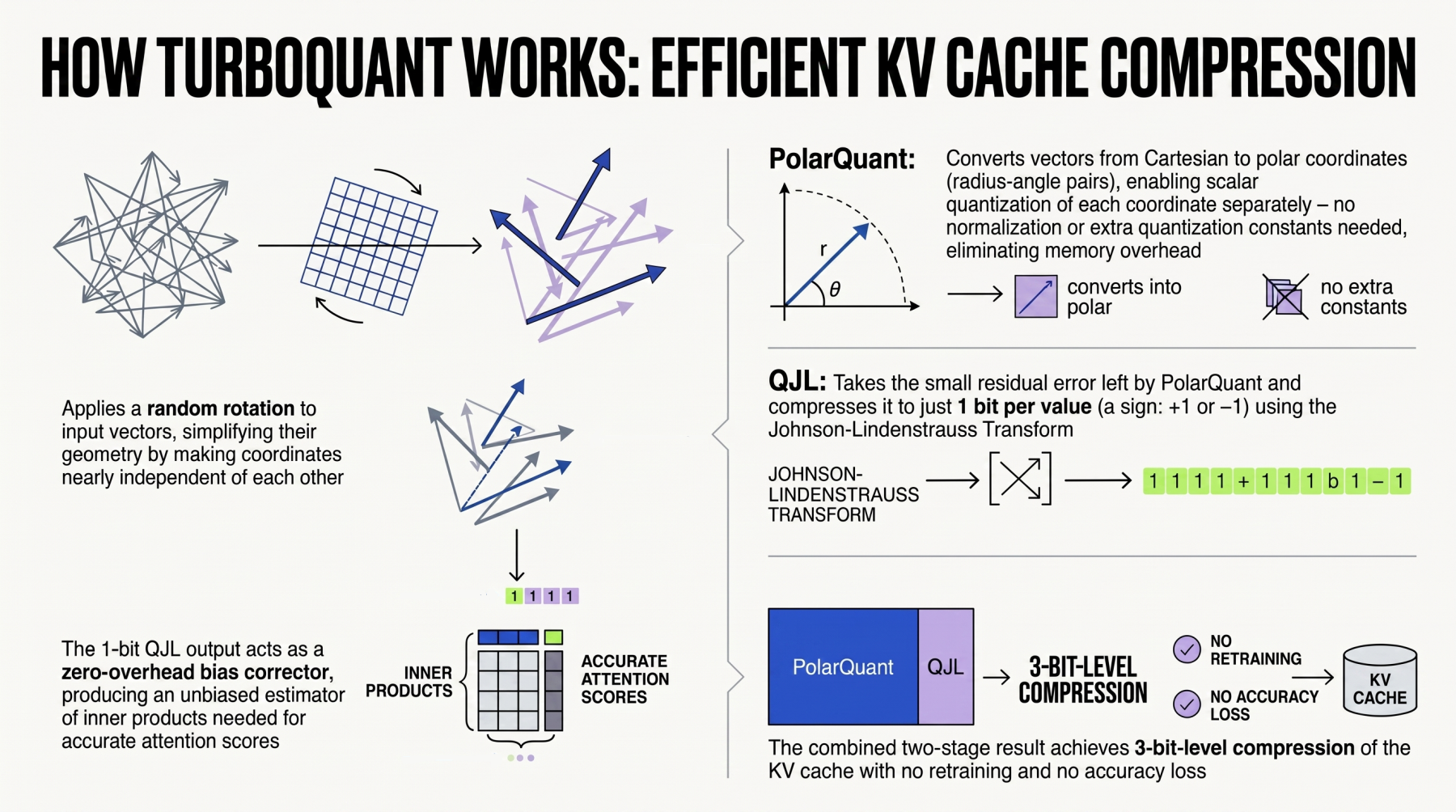
Large language models (LLMs) have revolutionized natural language processing, but their deployment at scale comes with significant memory and computational costs. A key bottleneck is the key-value (KV) cache, which stores intermediate representations during autoregressive generation. As sequence lengths grow, the KV cache can consume gigabytes of memory, limiting throughput and increasing latency. To address this, Google has introduced TurboQuant, a novel algorithmic suite and library that applies advanced quantization and compression techniques to both LLMs and vector search engines — the backbone of retrieval-augmented generation (RAG) systems.
Understanding KV Cache and Its Challenges
In transformer-based LLMs, each attention layer computes keys and values from input tokens. During generation, these are cached to avoid redundant computation. However, the cache size scales linearly with sequence length and batch size, often becoming the dominant memory consumer. Traditional solutions involve pruning or low-bit quantization, but they frequently degrade model quality. TurboQuant aims to achieve effective compression without compromising accuracy.
Why Compression Matters for RAG Systems
RAG systems combine LLMs with external knowledge bases, typically using vector search engines to retrieve relevant documents. These engines themselves rely on compressed vector representations for efficiency. TurboQuant unifies compression techniques for both the LLM's KV cache and the vector store, enabling end-to-end optimization. This is especially critical for real-time applications where low latency and high throughput are paramount.
How TurboQuant Works
TurboQuant employs a suite of algorithms that leverage post-training quantization and structured pruning. Unlike naive uniform quantization, it dynamically adjusts bit-widths based on the statistical properties of the KV tensor. By identifying outlier dimensions and applying mixed-precision schemes, TurboQuant reduces memory footprint by 2–4× while maintaining output quality within 1% of the full-precision model.
Quantization-Aware Calibration
The library includes a calibration step that collects activation statistics from a small set of representative inputs. Using these statistics, TurboQuant computes optimal quantization scales and zero-points for each layer. This calibration process is automated and requires minimal user intervention, making it accessible to practitioners without deep quantization expertise.
Structured Pruning of KV Cache
Beyond quantization, TurboQuant applies structured pruning to the cache: it removes entire keys or values that are rarely accessed during generation. This is guided by attention patterns, ensuring that only redundant entries are discarded. The pruning decisions are made offline and can be integrated into the model's forward pass with negligible overhead.
Benefits for LLM Deployment
With TurboQuant, developers can deploy larger models on the same hardware, or reduce the number of GPUs needed for serving. For example, a 70B parameter model with a 2048-token KV cache originally requiring 80GB of memory can be compressed to under 20GB, enabling inference on a single consumer-grade GPU. This dramatically lowers the barrier to entry for small teams and research groups.
Performance Benchmarks
Early benchmarks indicate that TurboQuant achieves a 4× compression ratio on the KV cache with less than 0.5% perplexity degradation on standard language modeling tasks. On vector search tasks in RAG pipelines, it reduces index size by 60% while preserving 98% recall. These results are competitive with the best known methods, but with significantly lower engineering complexity.
Integration with Existing Frameworks
TurboQuant is distributed as a Python library with a simple API. It integrates seamlessly with popular LLM frameworks like Hugging Face Transformers and vLLM. Users only need to wrap their model and call the calibration and compression routines. The library also supports exporting compressed models to ONNX and TensorRT for optimized inference.
Conclusion
Google's TurboQuant represents a significant step forward in making LLM inference more efficient. By focusing on the often-overlooked KV cache and extending to vector search engines, it addresses a critical pain point in production RAG systems. As LLMs continue to grow in size and usage, efficient compression techniques like TurboQuant will become indispensable for sustainable deployment.
Related Articles
- 5 Ways '101 BASIC Computer Games' Changed Personal Computing Forever
- The Design Organism: A Guide to Shared Leadership
- New 'macOS Apprentice' Tutorial Series Launches to Help Beginners Build Native Apps from Scratch
- Weekly Cyber Threat Landscape: Major Breaches, AI Vulnerabilities, and Critical Patches (May 11)
- Kazakhstan Strengthens Higher Education with Renewed Coursera Partnership: AI, Credit Courses, and Kazakh Language Expansion
- How to Pre-Configure Grafana Assistant for Instant Infrastructure Awareness
- Self-Described 'Worst Coder' Builds AI Agent That Dominates Coding Leaderboard – Sparks Debate on AI in Competitions
- AI's Uncertain Era and the Tech Revolution in Babymaking